What a wonderful, wonderful Savior,
Who would die on the cross for me!
Freely shedding His precious lifeblood,
That the sinner might be made free.
Chorus:
He was nailed to the cross for me,
He was nailed to the cross for me;
On the cross crucified for me He died;
He was nailed to the cross for me.
Thus He left His heavenly glory,
To accomplish His Father’s plan;
He was born of the virgin Mary,
Took upon Him the form of man.
He was wounded for our transgressions,
And He carried our sorrows, too;
He’s the Healer of ev’ry sickness,
This He came to the world to do.
So He gave His life for others
In Redeeming this world from sin,
And He’s gone to prepare a mansion,
That at last we may enter in.
Lyrics By Frederick Arthur Graves
Orphaned at age 9, Graves was diagnosed with epilepsy when he was 14. At age 21, he moved to Nobles County, Minnesota, and it appeared for a while that his seizures had stopped. Grateful for having been healed, he began to serve the American Sunday School Union. He studied the Bible and music in Chicago, Illinois, and Northfield, Massachusetts.
Upon return to Minneapolis and hearing evangelist John Alexander Dowie, Graves experienced permanent healing; this provided a backdrop for his Gospel songs. Later, he moved to Zion City, Illinois, where he lived the rest of his life. All of his children attended the Central Bible Institute in Springfield, Missouri. Graves himself was ordained an Assemblies of God minister in 1918.
H/T: Cyber Hymnal
Friday, April 14, 2006


Thursday, April 13, 2006

Wednesday, April 12, 2006
Things Left Behind...
Today was the day of the inspection of the “new” house (I say new, but it was built in ’66). As DH and the inspector dude were checking things out, I took some measurements and such. In my wanderings, I looked at a number of items that have been left behind. You know the ones—the little things that we really don’t want to move, but don’t know what else to do with them. It’s those little things that get added to an offer as “removal of personal items.” The normal things were there—a dresser, a couple of fishing rods, some outdoor toys and, well, Grandma.  Yes, there it was a burgundy velvet bag with a gold rope around the top. On the side of the bag was embroidered the name of a local funeral home. I am very curious (read nosy) so I had to check. I reached over and carefully pulled on the gold cord and took a peek. Inside the bag was a rose colored marble urn. Now, I am curious, but not so curious (read inquisitive) that I would open the urn to see if it really was Grandma inside. This was an assumption I was willing to make; after all, I don’t know too many people who purchase urns prior to needing one. I really am hoping that they remember to remove this one personal item in particular before closing. Either that or we will need to charge her for living in our adult foster home.
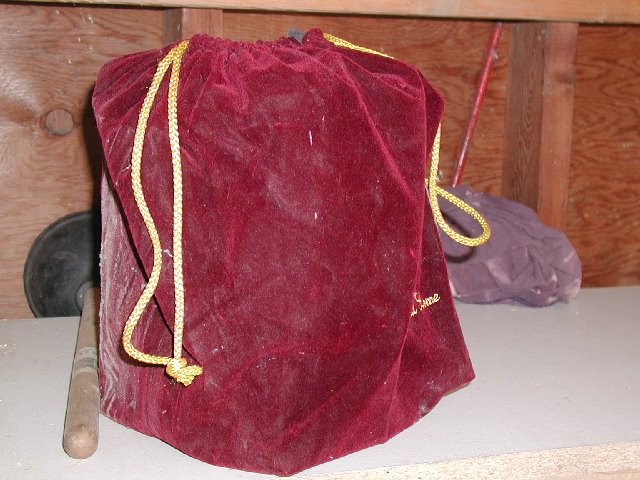 Yes, there it was a burgundy velvet bag with a gold rope around the top. On the side of the bag was embroidered the name of a local funeral home. I am very curious (read nosy) so I had to check. I reached over and carefully pulled on the gold cord and took a peek. Inside the bag was a rose colored marble urn. Now, I am curious, but not so curious (read inquisitive) that I would open the urn to see if it really was Grandma inside. This was an assumption I was willing to make; after all, I don’t know too many people who purchase urns prior to needing one. I really am hoping that they remember to remove this one personal item in particular before closing. Either that or we will need to charge her for living in our adult foster home.
Sunday, April 09, 2006
Eagle Cam
Click here to check this camera focused on an eagle's nest in Kent, Washington. It is really facinating.
H/T: Amazing Facts
H/T: Amazing Facts
All Hail the Power
They praised Him as He entered Jerusalem.
Yet just a few days later they crucified Him.
All hail the pow'r of Jesus' name, Let angels prostrate fall,
Bring forth the royal diadem. And crown Him Lord of all.
Bring forth the royal diadem. And crown Him Lord of all.
Ye chosen seed of Israel's race, Ye ransomed from the fall,
Hail Him who saves you by His grace. And crown Him Lord of all.
Hail Him who saves you by His grace. And crown Him Lord of all.
Let every kindred ev'ry tribe, On this terrestrial ball,
To Him all majesty ascribe. And crown Him Lord of all.
To Him all majesty ascribe. And crown Him Lord of all.
O that with yonder sacred throng, We at His feet may fall,
We'll join the everlasting song. And crown Him Lord of all.
We'll join the everlasting song. And crown Him Lord of all.
Lyrics by Edward Perronet, 1726-1792
Edward Perronet was born at Sundridge, Kent, England, in 1726. He was a descendant of a distinguished French Huguenot family who had fled to Switzerland and later to England because of the religious persecution in France. Edward's father, a pastor in the State Church of England,was strongly sympathetic with the evangelical movement spearheaded by the Wesleys and George Whitefield.
Edward, too, became a minister in the Anglican Church but was always critical of its ways. Once he wrote, "I was born and I am likely to die in the tottering communion of the Church of England, but I despise her nonsense." Soon, however, he broke from the Church and threw himself strenuously into the evangelistic endeavors of the Wesleys during the 1740's and 1750's. It was during this time that the Wesleys and their followers suffered much persecution and even violence from those who disagreed with their ministry. Concerning these experiences, Wesley made the following notation in his diary: From Rockdale we went to Bolton, and soon found that the Rockdale lions were lambs in comparison with those of Bolton. Edward Perronet was thrown down and rolled in mud and mire. Stones were hurled and windows broken. Another interesting account regarding the relationship between the Wesleys and Perronet concerns the incident when John Wesley announced to a congregation that Edward Perronet would preach at the next service. Being eighteen years younger than Wesley, Perronet had always refused to preach in the elder statesman's presence. Desiring to avoid a public conflict with Wesley, Perronet mounted the pulpit but quickly explained that he had never consented to preach. "However," he added, "I shall deliver the greatest sermon that has ever been preached on earth." He then read the Sermon on the Mount and sat down without comment. Eventually, Perronet's strong-mindedness and free spirit caused a break with the Wesleys, especially on the issue of whether the evangelists as well as the regular ministers could administer the sacraments. Perronet continued to the end of his days as pastor of an independent church at Canterbury, England. His last words have also become classic: Glory to God in the height of His divinity! Glory to God in the depth of His humanity! Glory to God in His all-sufficiency! Into His hands I commend my spirit. Though Perronet wrote many other hymns and forms of poetry, most of which he published anonymously, this is his only work to survive. The success of this text has, no doubt, been furthered by three fine tunes. "Coronation," composed by Oliver Holden, a Massachusetts carpenter, self-taught musician and respected singing-school teacher, is most widely used in America. "Miles Lane" by William Shrubsole, Perronet's personal friend, is the most popular in Great Britain, while the festive "Diadem" tune, composed in 1838 for this text by James Ellor, an English layman, is frequently used as a choir number.
Many interesting accounts have been associated with the use of this hymn. One of the most remarkable is a story told by E.P. Scott, a pioneer missionary to India. One day he was waylaid by a murderous band of tribesmen who were closing in on him with spears. On impulse the missionary took his violin out of his luggage and began to play and sing this hymn. When he reached the stanza "let every kindred, every tribe," he saw to his surprise every spear lowered and many of these tribesmen moved to tears. Scott spent the remaining years of his life preaching and ministering God's love and redemption to these people. God in His providence used a simple hymn as a means of introducing the gospel to a group of needy pagans.
H/T: 101 Hymn Stories by Kenneth Osbeck
Wednesday, April 05, 2006
Now We've Done It!
 We bought a new house today. It is 2800 sq ft on .88 of an acre. The floor plan is almost exactly what we were looking for and the lot is dividable so we can sell it or build on it. Our plan is to start an adult foster care specializing in dementia care.
  It is exciting and scary all at the same time. Yet we cannot continue with the day-to-day, paycheck-to-paycheck life. We want to do more and this way we can make a good living and give forward at the same time. Now it is on to the inspections and the packing and moving and the... Yikes, I need to get off the computer and get to work!
Walking on ice???
Sometimes believing the miracle is easier accepting the scientific explanation. I suppose some have so much trouble accepting a miracle because then they would have to accept that there is an omnipotent God. And to accept that would mean humans are responsible to Him.
Jesus may have walked on ice?
MIAMI (Reuters) - The New Testament says that Jesus walked on water, but a Florida university professor believes there could be a less miraculous explanation -- he walked on a floating piece of ice.
Professor Doron Nof also theorized in the early 1990s that Moses's parting of the Red Sea had solid science behind it.
Nof, a professor of oceanography at Florida State University, said on Tuesday that his study found an unusual combination of water and atmospheric conditions in what is now northern Israel could have led to ice formation on the Sea of Galilee.
Read the rest here.
Tuesday, April 04, 2006
YRE Volkswalk
 We headed out last Saturday for a YRE (Year Round Event) Volkswalk. That is a walk that starts at a specific location and is available most hours all year long. There is a box with a sign up sheet and maps. This one went through the Cedar Hills neighborhoods. The spring weather made for a nice walk and the flowers are really coming out. The hills were covered with new developments, most of which we
 would not choose to live in. We were surprised again by some of the paths that wandered between neighborhoods. We walked past a waterfall that we never knew was there, even thought we drive past it regularly. I love seeing the new sights that one does not notice until you meander past at a much slower pace.
Monday, April 03, 2006
Another Quiz...
Your Political Profile |
Overall: 95% Conservative, 5% Liberal |
Social Issues: 100% Conservative, 0% Liberal |
Personal Responsibility: 100% Conservative, 0% Liberal |
Fiscal Issues: 100% Conservative, 0% Liberal |
Ethics: 75% Conservative, 25% Liberal |
Defense and Crime: 100% Conservative, 0% Liberal |
Sunday, April 02, 2006
Alas! and Did My Savior Bleed?
Alas! and did my Savior bleed,
And did my Sovereign die!
Would he devote that sacred head
For sinners such as I?
Was it for crimes that I have done,
He groaned upon the tree?
Amazing pity! Grace unknown!
And love beyond degree!
Well might the sun in darkness hide,
And shut its glories in,
When God, the mighty maker, died
For his own creature's sin.
Thus might I hide my blushing face
While his dear cross appears;
Dissolve my heart in thankfulness,
And melt mine eyes to tears.
But drops of tears can ne'er repay
The debt of love I owe.
Here, Lord, I give myself away;
'Tis all that I can do.
And did my Sovereign die!
Would he devote that sacred head
For sinners such as I?
Was it for crimes that I have done,
He groaned upon the tree?
Amazing pity! Grace unknown!
And love beyond degree!
Well might the sun in darkness hide,
And shut its glories in,
When God, the mighty maker, died
For his own creature's sin.
Thus might I hide my blushing face
While his dear cross appears;
Dissolve my heart in thankfulness,
And melt mine eyes to tears.
But drops of tears can ne'er repay
The debt of love I owe.
Here, Lord, I give myself away;
'Tis all that I can do.
By Isaac Watts
Isaac Watts wrote many papers for places of higher learning but his most famous work is the hymn, “Alas! And Did My Savior Bleed.” Watts was born July 17, 1674, at Southampton, England. Such compelling lyrics came from a child born into a home of “non-Comformists” during the times when the Church of England persecuted Dissenters and Independents. His father was jailed twice during this time of persecution. Despite the fact that this era of intolerance lasted only a short while; it had a significant effect on Watts. In 1707, Watts wrote the lyrics to “Alas! And Did My Savior Bleed.” One line echoes such a impact, “Was it for crimes that I had done He groaned upon the tree?”
Isaac Watts humbly described his lyric writing ability, “I have made no pretence to be a poet. But to the Lamb that was slain, and now lives, I have addressed many a song, to be sung by the penitent and believing heart.” Hugh Wilson wrote the music to this hymn.
H/T: Gospel Piano
Subscribe to:
Posts (Atom)