Tuesday, February 28, 2006

21 Ways to be a Good Democrat

I got this in an e-mail today and had to share it with my blogger buddies. Enjoy!

1. You have to be against capital punishment, yet support abortion on demand.
2. You have to believe that businesses create oppression and governments create prosperity. (This one is really important)
3. You have to believe that guns in the hands of law-abiding Americans are more of a threat than U.S. nuclear weapons technology in the hands of Chinese and North Korean communists.
4. You have to believe that there was no art before Federal funding.
5. You have to believe that global temperatures are less affected by cyclical documented changes in the earth's climate and more affected by soccer moms driving SUV's.
6. You have to believe that gender roles are artificial but being homosexual is natural.
7. You have to believe that the AIDS virus is spread by a lack of federal funding.
8. You have to believe that the same teacher who can't teach 4th-graders how to read is somehow qualified to teach those same kids about sex.
9. You have to believe that outdoorsmen don't care about nature, but loony activists who have never been outside of San Francisco do.
10. You have to believe that self-esteem is more important than actually doing something to earn it.
11. You have to believe that Mel Gibson spent $25 million of his own money to make The Passion of the Christ for financial gain only.
12. You have to believe the NRA is bad because it supports certain parts of the constitution, while the ACLU is good because it supports certain parts of the Constitution.
13. You have to believe that taxes are too low, but ATM fees are too high.
14. You have to believe that Margaret Sanger and Gloria Steinem are more important to American history than Thomas Jefferson, Gen. Robert E. Lee and Thomas Edison.
15. You have to believe that standardized tests are racist, but racial quotas and set-asides are not.
16. You have to believe that Hillary Clinton is normal and is a very nice person.
17. You have to believe that the only reason socialism hasn't worked anywhere it's been tried is because the right people haven't been in charge.
18. You have to believe conservatives telling the truth belong in jail, but a liar and a sex offender belonged in the White House.
19. You have to believe that homosexual parades displaying drag, transvestites, and bestiality should be constitutionally protected and manger scenes at Christmas should be illegal.
20. You have to believe that illegal Democratic Party funding by the Chinese Government is somehow in the best interest to the United States.
21. You have to believe that this message is a part of a vast, right wing conspiracy.

Threes...

Death comes in threes. It may be an old superstition, but it sure rings true. Really, I'm not superstitious. I have broken mirrors and I do not worry if a black cat crosses my path. Okay, I don’t walk under ladders, but that just makes good sense from a safety perspective.

Yet, working in the long term care industry, deaths almost always come in threes. When there’s a death in a community, staff begins to wonder who will be next. Most don’t say anything about it. That way it may not come true. The week my mom died, we lost two others at work. A few years ago, we lost nine in one month. It was the hard on staff, residents and, of course, census.

Mind you, this is a bit tongue in cheek. I don’t like that I believe that death comes in threes. I don’t like being held to it. But it seems to work like that so much of the time. So, when some one I know dies, I cross my fingers and pray for everyone else I know and those who know those I know and those that know them.

Sunday, February 26, 2006

In the Garden

Verse 1:
I come to the garden alone,
While the dew is still on the roses;
And the voice I hear, falling on my ear,
The Son of God discloses.

Chorus:
And He walks with me, And He talks with me,
And He tells me I am His own;
And the joy we share as we tarry there,
None other has ever known.

Verse 2:
He speaks, and the sound of His voice Is so sweet,
The birds hush their singing,
And the melody that He gave to me,
Within my heart is ringing.

Verse 3:
I'd stay in the garden with Him,
Though the night around me be falling,
But He bids me go; Through the voice of woe,
His voice to me is calling.

Words by and Music by C. Austin Miles, 1868-1946

It was in 1912 that music publisher Dr. Adam Geibel (No. 85) asked C. Austin Miles to write a hymn text that would be "sympathetic in tone, breathing tenderness in every line; one that would bring hope to the hopeless, rest for the weary, and downy pillows to dying beds." In George W. Sanville's book, Forty Gospel Hymn Stories, Miles has left the following account of the writing of this hymn:

One day in March, 1912, I was seated in the dark room, where I kept my photographic equipment and organ. I drew my Bible toward me; it opened at my favorite chapter, John 20-whether by chance or inspiration let each reader decide. That meeting of Jesus and Mary had lost none of its power to charm.

As I read it that day, I seemed to be part of the scene. I became a silent witness to that dramatic moment in Mary's life, when she knelt before her Lord, and cried, "Rabboni!"

My hands were resting on the Bible while I stared at the light blue wall. As the light faded, I seemed to be standing at the entrance of a garden, looking down a gently winding path, shaded by olive branches. A woman in white, with head bowed, hand clasping her throat, as if to choke back her sobs, walked slowly into the shadows. It was Mary. As she came to the tomb, upon which she place her hand, she bent over to look in, and hurried away. John, in flowing robe, appeared, looking at the tomb; then came Peter, who entered the tomb, followed slowly by John. As they departed, Mary reappeared; leaning her head upon her arm at the tomb, she wept. Turning herself, she saw Jesus standing, so did I. I knew it was He. She knelt before Him, with arms outstretched and looking into His face cried "Rabboni!"

I awakened in full light, gripping the Bible, with muscles tense and nerves vibrating. Under the inspiration of this vision I wrote as quickly as the words could be formed the poem exactly as it has since appeared. That same evening I wrote the music.

Saturday, February 25, 2006

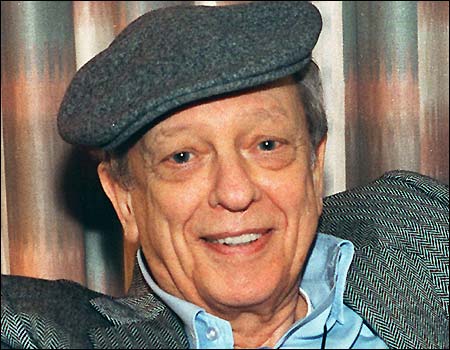
A Sad Day


Don Knotts
1924 ~ 2006

Don Knotts had an unforgettable sense of humor and comedic timing. I loved his character, Barney Fife, on The Andy Griffith Show. He would have me rolling on the floor laughing in The Ghost and Mr. Chicken and The Apple Dumpling Gang. He will be missed.

Biography

Don Knotts was born on July 21, 1924 in Morgantown, West Virginia. He had three older brothers: Sid, Bill and Shadow.

Don's first jump into the entertainment business was a ventriloquist. He and his dummy, Danny, were paid to perform at various parties and events around town. After graduating high school, Don went to New York City but wound up moving back home after a few weeks. He enrolled in West Virginia University (WVU).

At the age of 19, Don enrolled in the army and was transferred to a special service unit to entertain the troops during World War II. Don eventually got tired of his ventriloquist act, left his dummy on the beach and moved on to comedy. When the war was over, Don returned to WVU and graduated. Don got married and he and his wife moved back up to New York.

With the help of the connections he made in the service, Don was able to make a break into showbiz, doing radio shows and comedy clubs. His first big role was playing Windy Wales on the Bobby Benson radio show. He auditioned for and got a small role in the Broadway play No Time For Sergeants where he first met Andy Griffith. Don later reprised his role for the movie version.

Don also became a regular on the Tonight Show with Steve Allen, doing his nervous man routine for the Man-on-the-Street segments and bits in other sketches.

In 1959, the Tonight Show moved to Hollywood and Don moved with it to California. He heard that Andy Griffith was doing a new TV series about a small-town sheriff. He called Andy and suggested that the show needed a deputy. A few weeks later, Don got the part of Deputy Barney Fife. (Originally, Fife was referred to as Sheriff Andy Taylor's cousin, but the idea was later dropped.) Don won the Emmy for Best Supporting Actor five years in a row.

In 1964, Don starred in The Incredible Mr. Limpet. After that, he signed a five-year contract with Universal Pictures. He did The Ghost and Mr. Chicken (1965), The Reluctant Astronaut (1967), The Shakiest Gun in the West (1968), The Love God (1969) and How To Frame A Figg (1971).

After his movie contract was up, Don had a shortly lived variety show on NBC. He also divorced his wife, Kay, but remarried to woman named Loralee Czuchna. Don had two kids with Kay, a son and a daughter. Don started doing plays and guest appearances on other TV shows and eventually started doing movies with Tim Conway for Disney.

In 1979, Don got the role of Ralph Furley on Three's Company. After the show went off the air, Don revived his role as Barney Fife for an Andy Griffith Show reunion special. He did a few small TV appearances, including a recurring character on Matlock.

Although he hadn't had any major roles lately, Don kept himself busy with plays, doing cartoon voices and a part in Pleasentville. He eventually divorced his second wife, Loralee but was spending time with actress Francey Yarborough.

Friday, February 24, 2006

Spring Flowers

I took Casey out for a short walk this morning. I have been noticing the changes of spring coming quickly now. The crocus has been blooming, but now the daffodils are starting to show their heads. I love this time of year, seeing life coming from the cold earth and brightening each day.

Reading Meme

Mark had a new meme over at his place that was pretty cool. I love knowing what different people read. I think you get a whole new insight into one's soul by what they are reading.

So try this:

1. Pick up the book you're currently reading, or if that's not available, the nearest book.

2. Turn to page 21.

3. Go to the 14th (or closest to it) sentence.

4. Post the sentence, book title, and book author in the comments.

5. Continue this on your own blog with a different page and sentence from the same book.

One of the most bitter and cynical men I have ever known was a man loaded with talent.

How to Win Over Worry
By John Edmund Haggai

I originally read this book in High School as part of my required reading. It is one I need to read every so often as a reminder to be anxious for nothing.

I will confess I did a different book here than I did at Mark's. I tend to have more than one book going at a time. Currently I am reading three. This one, Dead Fall (Patricia Rushford & Harrison James) and Deja Dead (Kathleen J. Reichs). The last is on my PDA--a great way to read in bed!

Thursday, February 23, 2006

Walking Alone

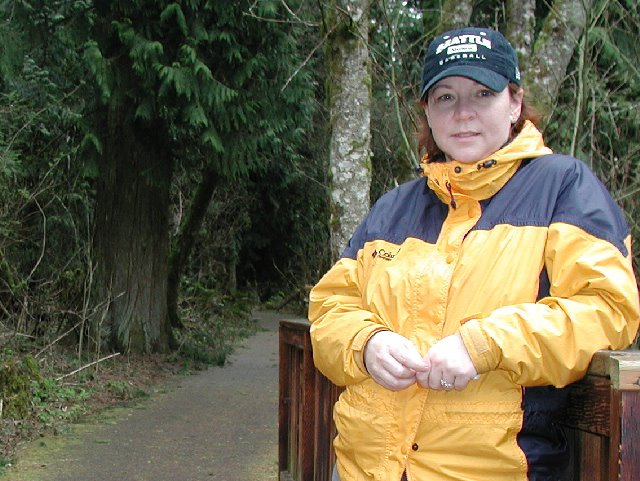
This afternoon, I headed out by myself. DH was working with his cousin and my destination did not allow dogs. I took an 11k volkswalk that started at the park district in Beaverton and traipsed through the Nike World Headquarters then on to the Nature Park. I crossed the MAX tracks and wandered back through another park and a few neighborhoods. It was a walk with a wide variety of milieus.

I have not walked through the Nike grounds before even though I drive by it often. It is a really nice campus and there were a couple of joggers. The nature park is one of my favorite places to walk, except dogs are not allowed. There are miles of trails both paved and unpaved. I often see bunnies, Gartner snakes and a variety of ducks and birds. Today though, I saw only a few mallard ducks and one robin. I love the solitude and the time to think.

One of the best parts was that I finished just as the sky opened up and the rain poured on down. Walking in the mist is fine, but it sure gets cold when it comes down like that.

Monday, February 20, 2006

President's Day

The original version of President's Day was in commemoration of George Washington's birthday in 1796. Washington, according to the calendar that has been used since at least the mid-18th century, was born on February 22, 1732. According to the old style calendar in use back then, however, he was born on February 11. At least in 1796, many Americans celebrated his birthday on the 22nd while others marked the occasion on the 11th instead.
By the early 19th century, Washington's birthday had taken firm root in the American experience as a bona fide national holiday. Its traditions included Birthnight Balls in various regions, speeches and receptions given by prominent public figures, and a lot of revelry in taverns throughout the land. Then along came Abraham Lincoln, another revered president and fellow February baby (born on the 12th of the month). The first formal observance of his birthday took place in 1865, the year after his assassination, when both houses of Congress gathered for a memorial address. While Lincoln's Birthday did not become a federal holiday like George Washington's, it did become a legal holiday in several states.
In 1968, legislation (HR 15951) was enacted that affected several federal holidays. One of these was Washington's birthday, the observation of which was shifted to the third Monday in February each year whether or not it fell on the 22nd. This act, which took effect in 1971, was designed to simplify the yearly calendar of holidays and give federal employees some standard three-day weekends in the process.
Apparently, while the holiday in February is still officially known as Washington's Birthday (at least according to the Office of Personnel Management), it has become popularly (and, perhaps in some cases at the state level, legally) known as "President's Day." This has made the third Monday in February a day for honoring both Washington and Lincoln, as well as all the other men who have served as president.

Sunday, February 19, 2006

What a Friend We Have in Jesus

Words By Joseph Scriven

What a Friend we have in Jesus, all our sins and griefs to bear!
What a privilege to carry everything to God in prayer!
O what peace we often forfeit, O what needless pain we bear,
All because we do not carry everything to God in prayer.

Have we trials and temptations? Is there trouble anywhere?
We should never be discouraged; take it to the Lord in prayer.
Can we find a friend so faithful who will all our sorrows share?
Jesus knows our every weakness; take it to the Lord in prayer.

Are we weak and heavy laden, cumbered with a load of care?
Precious Savior, still our refuge, take it to the Lord in prayer.
Do your friends despise, forsake you? Take it to the Lord in prayer!
In His arms He’ll take and shield you; you will find a solace there.

Blessed Savior, Thou hast promised Thou wilt all our burdens bear
May we ever, Lord, be bringing all to Thee in earnest prayer.
Soon in glory bright unclouded there will be no need for prayer
Rapture, praise and endless worship will be our sweet portion there.

More than a century ago, on the streets of Port Hope, Ontario, a man could be seen walking along carrying a saw and a sawhorse. One day a rich man from across the street saw him and said to a friend, "He looks like a sober man. I think I'll hire him to cut wood for me." "That's Joseph Scriven," the friend replied. "He wouldn't cut wood for you. He only cuts wood for those who don't have enough to pay." And that sums up the philosophy of Joseph Medlicott Scriven, a devoted member of the Plymouth Brethren Church, who took the Sermon on the Mount literally.

Scriven was born in Dublin, Ireland, in 1819. He fell for a lovely young woman, but on the eve of their wedding she accidentally drowned. Scriven never recovered from the shock. The Irishman began to wander, hoping to forget his sorrow. At age 25, he finally settled in Canada.

His faith led him to do menial tasks for poor widows and the sick. He often worked for no wages and was regarded by the people of the community as a kind man, albeit a bit odd. He later fell in love again and planned to marry a wonderful Canadian woman. But again, tragedy struck. His fiance died after contracting pneumonia.

In 1855, a friend visited an ill Scriven and discovered a poem that he had written for his ailing mother in faraway Ireland. Scriven didn't have the money to visit her, but he sent her the poem as an encouragement. He called it "Pray Without Ceasing." When the friend inquired about the poem's origins, Scriven reportedly answered, "The Lord and I did it between us."

Scriven never intended for the poem to be published, but it made its rounds, and was set to music in 1868 by musician Charles Converse, who titled it "What a Friend We Have in Jesus." It has since become one of our greatest hymns.

Scriven died in 1886 (ironically, in an accidental drowning). In his memory, the town of Port Hope erected a monument with this inscription from Scriven's famous song: In His arms He'll take and shield thee. Thou wilt find a solace there

Friday, February 17, 2006

Silly Dog

This afternoon, Casey & I walked to the bank. Tellers are usually a bit suprised to see me walk in with my dog although most at this branch have become accustomed to it by now. I will not leave him tied up outside. I am afraid he might get loose or someone might take him. That would break my heart.

Anyway, today the teller was new and after she smiled she asked if he would like a dog treat. I said sure. I gave the bone to Casey and stopped for a minute outside the bank so he could take some time to eat it. He just looked at me like, "What are we stopping for, Mom? Let's get moving!" So, we did. He started with a new lilt in his step and carried that bone the 2 miles back home. He slobbered all over the place, but he would not set it down or eat it. Of course, after we were in the house, he went straight to the back door to get to the yard so he could eat it.

To let you know how cold it is here today. When we got home, I wiped his chin to get a picture of him with it and some of the slobber had frozen on his fur. It is in the low 30s today, but the wind is coming in from the northeast and bringing a cold snap. Brrr!